

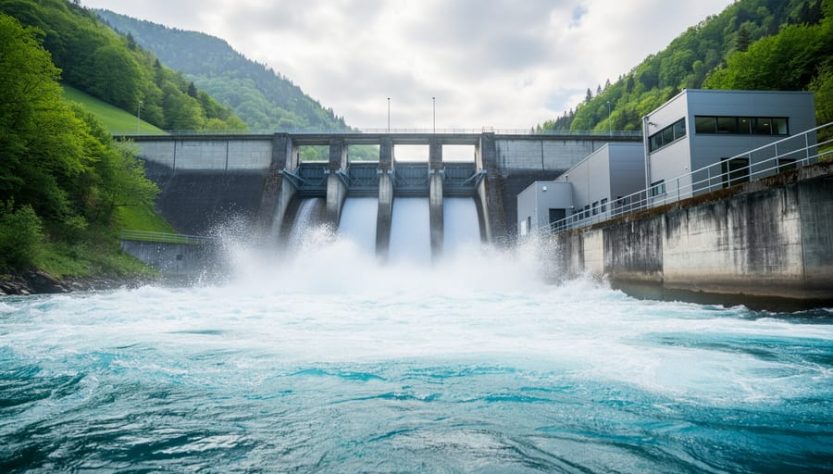
Hydropower is renewable energy because it harnesses the continuous water cycle, where evaporation, precipitation, and runoff naturally replenish the resource without depleting it over time. Unlike fossil fuels that form over millions of years and vanish once burned, rivers flow season after season, making hydroelectric generation fundamentally inexhaustible under stable climatic conditions.
This classification matters because hydropower supplies roughly 16% of global electricity in 2026, representing humanity’s largest source of renewable power by total output. Yet the question persists in public discourse, fueled by legitimate concerns about dam-related environmental damage, methane emissions from tropical reservoirs, and displacement of communities. The confusion stems from conflating two distinct concepts: renewable refers to resource replenishment, while sustainable addresses broader ecological and social impacts.
The water powering turbines today returns to the atmosphere through evaporation, falls as rain or snow across watersheds, and flows back through the system in a perpetual loop driven by solar energy. This mechanism defines renewability in its purest form. A coal plant exhausts its fuel permanently; a hydroelectric facility uses the same molecules repeatedly across decades of operation.
This article provides the technical foundation for understanding hydropower’s renewable status, examines how different system types from run-of-river to pumped storage interact with that classification, and addresses the critical distinction between renewable and sustainable that shapes modern energy policy. You’ll gain clarity on why hydropower unequivocally qualifies as renewable while simultaneously grappling with environmental trade-offs that demand careful project design and site selection.
What Is Hydropower and How Does It Generate Electricity?
Hydropower harnesses the energy of moving or falling water to generate electricity, making it one of humanity’s oldest and most reliable power sources. At its core, hydropower works by capturing water’s mechanical energy, whether from a river’s natural flow, a controlled reservoir release, or tidal movements, and converting it into electrical energy through turbines and generators. This conversion process transforms the physical force of water into the electrons that power homes, businesses, and industries.
The technology relies on two fundamental forms of energy inherent in water: potential energy, which exists when water is held at height, and kinetic energy, which manifests when water moves. A hydropower facility positions itself to exploit one or both of these energy states, channeling water through carefully designed systems that maximize power output while maintaining continuous operation.
- Hydropower
- The conversion of energy from flowing or falling water into usable electricity, utilizing the natural or controlled movement of water resources.
- Hydroelectricity
- The electrical power produced by hydropower installations, representing approximately 16% of global electricity generation as of 2026.
- Potential Energy
- The stored energy water possesses due to its elevation above a lower point, which increases proportionally with height and volume.
- Kinetic Energy
- The energy of motion that water carries as it flows, determined by the water’s mass and velocity.
- Renewable Energy
- Energy derived from sources that naturally replenish on human timescales, such as sunlight, wind, and, critically, the water cycle.
Hydropower qualifies as renewable because it depends on the water cycle, an endlessly repeating natural process driven by solar energy. Rain and snowmelt continuously replenish rivers and reservoirs, creating a self-sustaining energy source that doesn’t deplete finite resources. Unlike fossil fuels, which took millions of years to form and disappear when burned, the water used to generate hydroelectricity remains in the system, ready to cycle through again. This fundamental characteristic, drawing from a naturally replenishing resource, places hydropower squarely within the renewable energy category alongside wind, solar, and geothermal power.
How Hydropower Works: The Energy Conversion Process
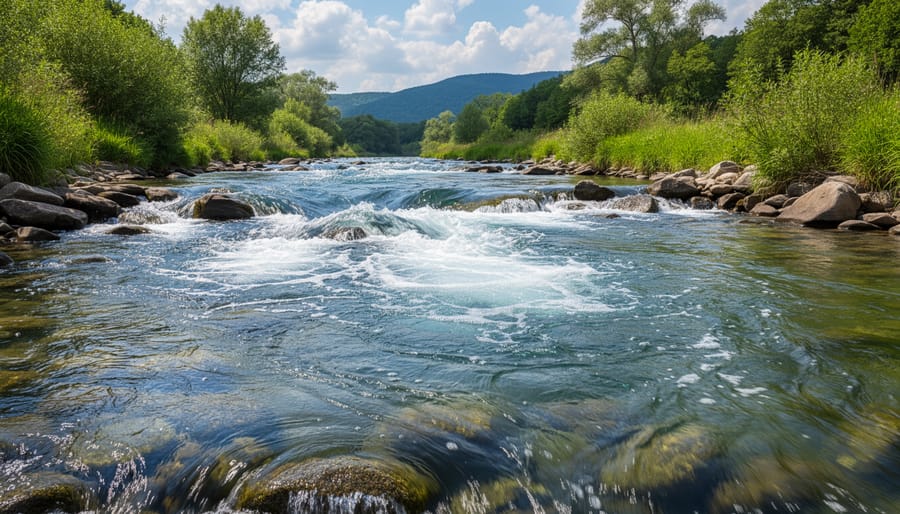
Hydropower transforms the natural movement of water into electrical energy through a straightforward mechanical process. When water flows from a higher elevation to a lower one, gravity pulls it downward, creating kinetic energy. In a hydropower facility, engineers channel this moving water through a penstock, a large pipe or tunnel, that directs the flow toward turbines housed in the powerhouse.
As the pressurized water strikes the turbine blades, it causes the rotor to spin rapidly. The turbine connects directly to a generator shaft, and this spinning motion activates electromagnetic coils inside the generator. The rotating magnetic field produces an electric current, which transformers then step up to high voltage for transmission across power grids. The water exits through the tailrace and continues downstream, unchanged in chemical composition and available for reuse.
The conversion efficiency of this process reaches 90% in modern installations, far exceeding fossil fuel plants. No combustion occurs, no fuel gets consumed, and the water itself remains undiminished. After passing through the turbine, it rejoins natural waterways and eventually evaporates, forming clouds that later release precipitation back into rivers and reservoirs.
This is where the renewable classification becomes clear. The sun continuously drives the hydrological cycle, evaporating water from oceans and lakes, which then falls as rain or snow in watersheds upstream. Gravity pulls this precipitation back to lower elevations, replenishing the rivers that feed hydropower facilities. The cycle runs perpetually without depleting the water resource itself.
Unlike fossil fuels that form over millions of years and diminish with extraction, water moves through this cycle in days, weeks, or months depending on the watershed. A hydropower plant can operate indefinitely as long as precipitation patterns maintain adequate flow, making the resource fundamentally renewable. The facility harnesses energy from water’s continuous journey through Earth’s natural systems rather than drawing down a finite stock.
Types of Hydropower Systems and Technologies
Conventional Impoundment Dams
Conventional impoundment dams create large reservoirs by blocking rivers, storing vast quantities of water that operators release through turbines on demand. These facilities typically generate hundreds of megawatts to several gigawatts, providing reliable baseload power that utilities can ramp up or down to match electricity demand. The stored water represents a renewable resource continuously replenished by rainfall and snowmelt through the natural hydrological cycle, meeting the technical definition of renewable energy.
However, impoundment dams spark the most intense sustainability debates within hydropower. Reservoir creation floods large land areas, fundamentally altering ecosystems and displacing communities. Decomposing organic matter in tropical reservoirs produces methane, a potent greenhouse gas that can diminish climate benefits. Dams disrupt fish migration, change downstream water temperature and sediment patterns, and fragment river ecosystems. The renewable classification remains valid since water supply renews naturally, yet these environmental and social costs explain why advocacy groups increasingly distinguish between technically renewable sources and genuinely sustainable ones. Modern dam projects incorporate fish passages, environmental flow requirements, and comprehensive impact assessments to address these concerns.
Run-of-River Systems
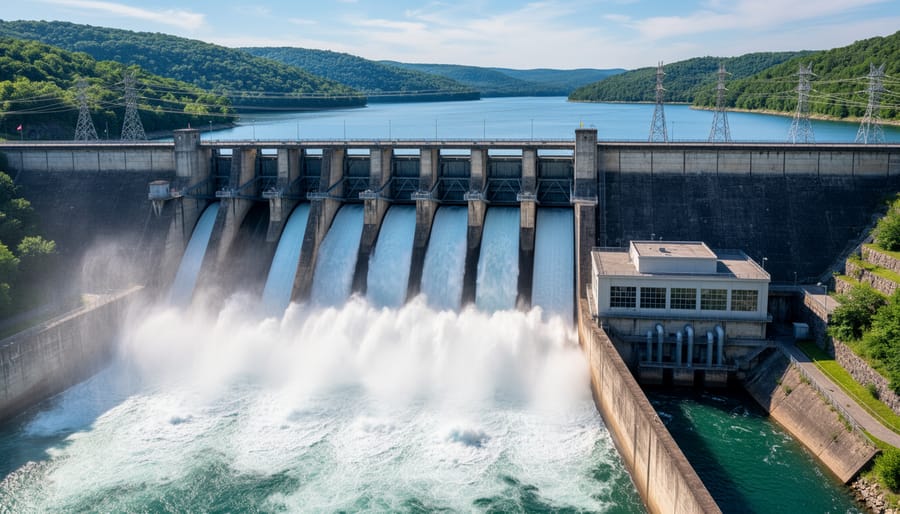
Run-of-river systems generate electricity from a river’s natural flow without creating large reservoirs. Water diverts through a canal or penstock to turbines, then immediately returns downstream. Unlike conventional dams, these facilities don’t store significant water volumes, they work with whatever flow the river provides at any given moment.
This design makes run-of-river systems exceptionally renewable. They impose minimal disruption to the water cycle, allowing seasonal variations to continue naturally. Fish can often migrate more easily than around massive dams, and flooding upstream communities becomes unnecessary since no reservoir exists. The environmental footprint stays relatively small.
However, power output fluctuates with river conditions. During dry seasons, generation drops considerably. During floods, systems may shut down entirely to prevent damage. This variability means run-of-river facilities work best as part of a diversified energy mix rather than standalone baseload sources. Their renewable credentials remain strong precisely because they adapt to nature’s rhythms instead of controlling them.
Pumped-Storage Hydropower
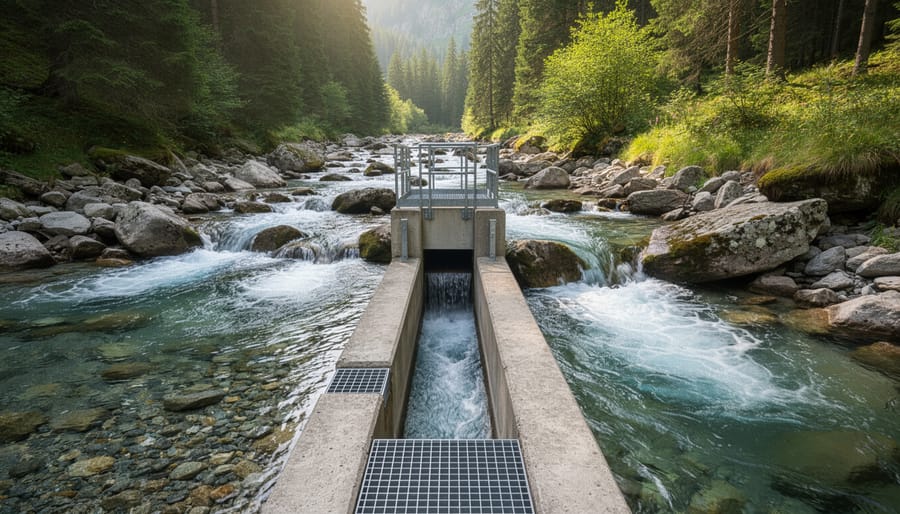
Pumped-storage hydropower functions as a massive battery, pumping water uphill to an elevated reservoir during periods of low electricity demand, then releasing it through turbines when power is needed. This two-way system doesn’t generate net new energy, it consumes electricity to pump water up, but serves as critical energy storage infrastructure for modern grids. When paired with intermittent renewables like wind and solar, pumped storage stores excess generation during peak production hours and dispatches it during calm or nighttime periods. The technology qualifies as renewable because it relies on the same water cycle and gravity principles as conventional hydropower, with efficiency rates reaching 70-85%. By 2026, pumped storage represents the largest share of grid-scale energy storage worldwide, providing the flexibility necessary to maintain stable electricity supply as renewable generation expands.
Small and Micro-Hydro Systems
Small and micro-hydro systems represent hydropower at its most accessible scale, typically generating less than 10 megawatts (small-hydro) or under 100 kilowatts (micro-hydro). These installations operate on natural water flow in streams, irrigation channels, or existing water infrastructure without requiring large dams or reservoirs.
Their minimal environmental footprint makes them particularly attractive for remote communities and distributed generation. Most run-of-river designs divert a portion of stream flow through a small turbine before returning it downstream, leaving aquatic ecosystems largely intact. Installation costs have dropped significantly, with micro-hydro systems now viable for individual farms, villages, and off-grid applications.
The renewable credentials are exceptional: continuous baseload power from natural flow, no fuel requirements, decades-long operational lifespans, and negligible greenhouse gas emissions. Unlike large dams, these systems avoid methane production from flooded vegetation and typically require no land clearing or population displacement, addressing the sustainability concerns that complicate larger hydropower projects.
The Renewable Energy Criteria: Why Hydropower Qualifies
An energy source earns the renewable label when it relies on resources that nature replenishes faster than we consume them. Hydropower clears this bar decisively through three fundamental attributes: the solar-powered water cycle continuously restocks its fuel supply, the generation process consumes no raw material, and the resource remains available indefinitely with proper watershed management.
The water cycle operates as hydropower’s perpetual engine. Solar radiation evaporates water from oceans, lakes and rivers, atmospheric currents carry moisture inland, precipitation falls across watersheds, and gravity pulls that water back toward sea level. This closed-loop system delivers a fresh supply of potential energy to river systems regardless of how much electricity we generate. Unlike fossil fuel deposits that took millions of years to form and deplete with extraction, the water that spins a turbine today returns to the cycle tomorrow, ready to drive turbines again downstream or in future precipitation cycles.
The non-depletion criterion separates renewables from finite resources. When a hydroelectric facility generates a megawatt-hour of electricity, it extracts kinetic energy from flowing water but returns that water to the river system chemically unchanged and fully available for downstream use or ecosystem function. The resource itself passes through rather than disappears. A coal plant, by contrast, converts its fuel into ash and emissions that cannot regenerate on human timescales.
Continuous availability distinguishes hydropower from truly intermittent renewables. While solar panels go dark at night and wind turbines idle in calm conditions, rivers fed by large watersheds maintain flow year-round, providing dispatchable generation on demand. Seasonal variations exist, but the underlying resource remains accessible every hour of every day. This reliability stems from watershed storage capacity, where precipitation that fell months earlier continues feeding streamflow through groundwater seepage and snowpack melt, smoothing out the water cycle’s natural fluctuations into steady energy availability.
Current Uses and Applications of Hydropower
Hydropower supplied approximately 16% of global electricity generation in 2026, making it the largest renewable electricity source worldwide despite rapid growth in wind and solar capacity. This mature technology serves multiple critical functions across diverse geographies, from massive installations along major river systems to distributed generation in remote communities.
The primary application remains baseload electricity generation, where hydropower plants operate continuously to meet steady demand. Large facilities in countries like China, Brazil, Canada, Norway, and the United States provide reliable power that doesn’t fluctuate with weather conditions, unlike solar and wind. China alone operates over 370 gigawatts of hydropower capacity, while Brazil derives roughly 60% of its electricity from water resources.
Modern hydropower facilities serve several interconnected purposes:
- Grid baseload power: continuous electricity generation meeting constant demand
- Peak demand response: rapid output adjustment during high-consumption periods
- Energy storage: pumped-storage systems that bank excess renewable energy
- Irrigation support: controlled water release for agricultural operations
- Flood control: reservoir management reducing downstream flood risk
- Renewable energy balancing: compensating for solar and wind variability
The integration function has become increasingly valuable as grids incorporate more variable renewables. Hydropower plants can ramp output up or down within minutes, filling gaps when wind dies or clouds pass over solar arrays. Pumped-storage facilities now represent about 160 gigawatts of global capacity, effectively functioning as giant batteries that store energy during low-demand periods and release it when needed.
Regional distribution reflects geography and development patterns. Asia-Pacific accounts for nearly half of global hydropower capacity, followed by the Americas and Europe. Emerging markets in Southeast Asia and Sub-Saharan Africa are expanding capacity, while established markets focus on modernizing aging infrastructure and adding generation capability to existing dams.
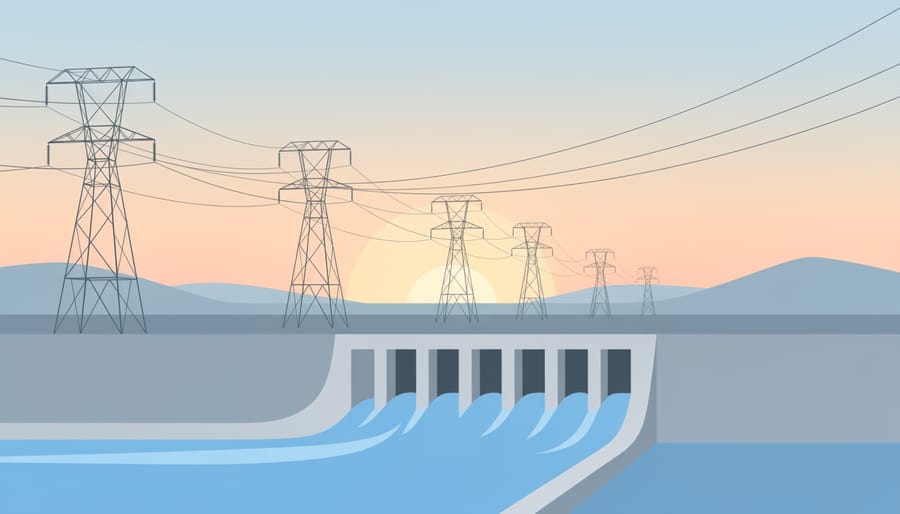
The Sustainability Debate: Environmental and Social Considerations
While hydropower undeniably meets the technical criteria for renewable energy, a more complex question divides the environmental community: is it sustainable? This distinction matters because a resource can be renewable, continuously replenished by natural processes, without being environmentally or socially benign in its implementation.
The most significant ecological concern centers on large reservoir systems. When rivers are dammed to create storage reservoirs, the resulting changes extend far beyond the immediate flood zone. Downstream ecosystems face altered flow patterns that disrupt sediment transport, change water temperature, and block nutrient cycling. Fish populations, particularly migratory species like salmon, suffer when their traditional routes are severed. Upstream, flooded land decomposes under anaerobic conditions, releasing methane, a greenhouse gas with 80 times the warming potential of carbon dioxide over 20 years. Tropical reservoirs produce especially significant emissions, sometimes rivaling fossil fuel plants in their carbon impact during the first decade of operation.
The human cost can be equally profound. Large dam projects have historically displaced millions of people from ancestral lands, often with inadequate compensation or resettlement support. Indigenous communities face particular vulnerability when traditional territories disappear beneath reservoir waters. These social disruptions raise ethical questions about who bears the cost of renewable energy development and whether such trade-offs can ever be justified.
Modern hydropower development increasingly acknowledges these tensions. Environmental flow requirements now mandate releases that mimic natural river patterns, supporting downstream ecosystems. Fish passages, from simple ladders to sophisticated lifts, help maintain migration routes. New projects undergo rigorous environmental and social impact assessments before approval. Run-of-river systems avoid reservoir creation entirely, eliminating methane concerns and displacement issues while generating clean electricity.
The sustainability debate ultimately reflects competing values rather than a simple yes-or-no question. Hydropower’s renewable status remains technically sound, but responsible advocates recognize that classification alone doesn’t address real environmental and social consequences. The path forward requires balancing climate benefits against local impacts, prioritizing low-impact designs, retrofitting existing facilities with modern mitigation measures, and ensuring affected communities have meaningful voice in energy decisions.
Hydropower’s Role in Renewable Energy Advocacy and Future Outlook
Renewable energy advocates recognize hydropower as essential infrastructure for achieving climate goals, though the focus has shifted toward sustainable implementation rather than uncritical expansion. Major environmental organizations now emphasize modernizing existing facilities and developing low-impact projects rather than abandoning hydropower entirely, acknowledging its unique ability to provide reliable baseload power that intermittent sources cannot match alone.
Hydropower’s complementary relationship with wind and solar makes it increasingly valuable as these technologies grow. While debates around wind vs hydropower often position them as competing options, grid operators view them as partners. Hydropower facilities can ramp output up or down within minutes to compensate for fluctuating wind and solar generation, effectively acting as giant batteries that smooth renewable energy supply. This flexibility becomes more critical as grids incorporate higher percentages of variable renewables.
The advocacy community increasingly distinguishes between large dam construction and modernization strategies. Upgrading existing facilities with modern turbines, fish-friendly designs, and improved flow management can boost output by 15-30% while reducing ecological harm. In developing nations small-scale and run-of-river projects receive support as alternatives to fossil fuels, provided they incorporate community input and environmental safeguards from the planning stage.
Looking ahead, the role of pumped-storage hydropower will likely expand as energy storage needs intensify. Rather than building new dams, the industry is exploring closed-loop systems that recirculate water between reservoirs without river connections, offering storage capacity without the ecosystem disruption that sparked earlier controversies.
Frequently Asked Questions About Hydropower as a Renewable Resource
Is Hydropower Actually Renewable or Just Called That?
Yes, hydropower is genuinely renewable because it relies on the water cycle, which continuously replenishes water sources through evaporation and precipitation. Unlike fossil fuels that deplete finite reserves, flowing water is naturally restored, making hydropower meet the core definition of renewable energy. However, the sustainability of specific projects depends on their design and implementation.
Does Hydropower Produce Any Greenhouse Gas Emissions?
While hydropower generates electricity without burning fossil fuels, some reservoir systems do produce methane emissions from decomposing organic matter in flooded areas. Run-of-river systems produce minimal emissions, and overall, hydropower’s carbon footprint remains far lower than coal or natural gas. Modern reservoir management techniques can significantly reduce these emissions.
How Does Hydropower Compare to Solar and Wind Energy?
Hydropower offers advantages that solar and wind cannot match, particularly dispatchability and energy storage through pumped-storage systems. Unlike intermittent renewables, hydropower facilities can provide steady baseload power and quickly adjust output to meet demand fluctuations. This makes hydropower essential for grid stability, especially as renewable breakthroughs in solar and wind increase their share of the energy mix.
Can Large Dam Projects Be Considered Sustainable?
Large dams present sustainability challenges including ecosystem disruption and community displacement, which is why many advocates distinguish between renewable and sustainable energy. However, modern hydropower development incorporates environmental flow requirements, fish passage systems, and stakeholder consultation to minimize impacts. The key is responsible planning and mitigation measures rather than abandoning hydropower entirely.
What Is the Future Outlook for Hydropower Development?
The focus is shifting toward modernizing existing facilities, adding generation capacity to non-powered dams, and developing small-scale run-of-river systems that minimize environmental impact. Pumped-storage hydropower is experiencing renewed interest as a crucial tool for storing excess renewable energy and stabilizing grids with high penetrations of variable sources.
Is hydropower truly renewable?
Yes, hydropower is renewable because it uses the water cycle, which naturally and continuously replenishes water sources through evaporation and precipitation. This makes it fundamentally different from fossil fuels that deplete finite resources.
Does hydropower produce emissions?
Hydropower generates electricity without combustion, but large reservoirs can produce methane from decomposing organic matter. Run-of-river systems produce negligible emissions, and overall, hydropower’s carbon footprint is far lower than fossil fuel alternatives.
How does it compare to solar and wind?
Hydropower provides dispatchable power and energy storage capabilities that solar and wind cannot, making it essential for grid stability. While all three are renewable, hydropower’s ability to quickly adjust output and store energy makes it uniquely valuable for integrating intermittent renewables.
Can hydropower be sustainable?
Hydropower can be sustainable when projects incorporate environmental flow requirements, fish passage systems, and stakeholder consultation. Modern development focuses on minimizing ecosystem disruption and social impacts through careful planning and mitigation measures.
The questions readers ask about hydropower’s renewable status reflect broader concerns about balancing clean energy needs with environmental stewardship. Understanding these nuances helps clarify why hydropower remains a vital component of renewable energy strategies despite legitimate sustainability considerations that require ongoing attention.
Types or components
Hydropower facilities consist of several integrated components that work together to generate renewable electricity from water flow. The dam structure creates elevation difference and water storage capacity, controlling flow rates to match electricity demand. Modern dams incorporate fish passages and environmental flow requirements to minimize ecological disruption while maintaining renewable energy production.
Turbines convert water’s kinetic energy into mechanical rotation, with designs varying by site conditions, Francis turbines for medium-head applications, Kaplan turbines for low-head run-of-river systems, and Pelton wheels for high-head installations. The generator transforms this mechanical energy into electrical power distributed through the grid.
Control systems optimize output by adjusting water release rates based on electricity demand and hydrological conditions. Advanced monitoring equipment tracks environmental parameters, ensuring operations comply with sustainability standards. Many facilities now integrate flexible generation capacity that complements variable solar and wind sources, with operators earning renewable energy credits for clean power production that supports grid decarbonization goals while maintaining baseload stability.
Hydropower stands as a renewable energy source by every technical definition. The water cycle continuously replenishes rivers and reservoirs through evaporation and precipitation, creating an energy resource that won’t deplete with use. This natural regeneration cycle operates independently of human consumption, meeting the fundamental criterion that separates renewable from finite resources like coal or natural gas.
Yet the renewable classification tells only part of the story. Environmental and social sustainability depend heavily on implementation. Large dams can fragment ecosystems and displace communities, while poorly sited facilities may produce unexpected methane emissions. These impacts don’t negate hydropower’s renewable status, but they demand thoughtful project design, rigorous environmental assessment, and meaningful community engagement.
The distinction matters for clean energy planning. Hydropower already supplies roughly 16% of global electricity and provides essential grid stability that enables higher penetration of intermittent sources like wind and solar. Dismissing it wholesale would make decarbonization goals significantly harder to achieve. The path forward lies in modernizing existing facilities, prioritizing run-of-river and small-hydro projects where appropriate, and applying today’s environmental standards to new development.
Hydropower remains renewable. Making it sustainable requires treating water resources and affected communities with the same care we apply to climate goals. Both objectives can coexist when we choose technology and locations wisely.